Why Silver Hair Turns Yellow and What Actually Helps

Silver hair turns yellow because the melanin that once filled the cortex and provided a buffer against environmental staining is no longer present. Without that pigment, the hair shaft absorbs compounds from water, smoke, products, and sunlight that deposit a yellow or brassy tone on the surface and within the fiber. I noticed the first yellow cast on my hair about four months into my transition, and it took me another two months to identify which of the several possible causes was responsible.
The yellowing of silver hair has four primary causes: mineral deposits from hard water, UV exposure, product buildup, and environmental pollutants. Each cause has a different mechanism and a different solution, and the treatment that works for one will not necessarily work for another. Identifying which cause is active in your hair is the first step toward correcting it.
The Structural Reason Silver Hair Yellows

Pigmented hair contains melanin granules distributed throughout the cortex. Those granules absorb certain wavelengths of light and reflect others, which produces the color you see. When melanin production stops and the hair grows in silver or white, the cortex is left without those granules. The resulting fiber is essentially transparent, and it reflects whatever light hits it or whatever compounds have settled on its surface.
The thicker cuticle on gray hair, which I discussed in relation to texture changes, also plays a role in yellowing. The more textured surface of a thicker cuticle provides more area for environmental compounds to adhere to. Mineral ions from water, nicotine particles from smoke, and residue from styling products all accumulate on that rougher surface more readily than on the smoother cuticle of younger, pigmented hair.
The combination of a transparent cortex and a textured cuticle means that silver hair functions almost like a filter, capturing and displaying whatever it comes into contact with most frequently. The yellowing is not a flaw in the hair. It is a consequence of its structure interacting with its environment.
Hard Water and Mineral Deposits
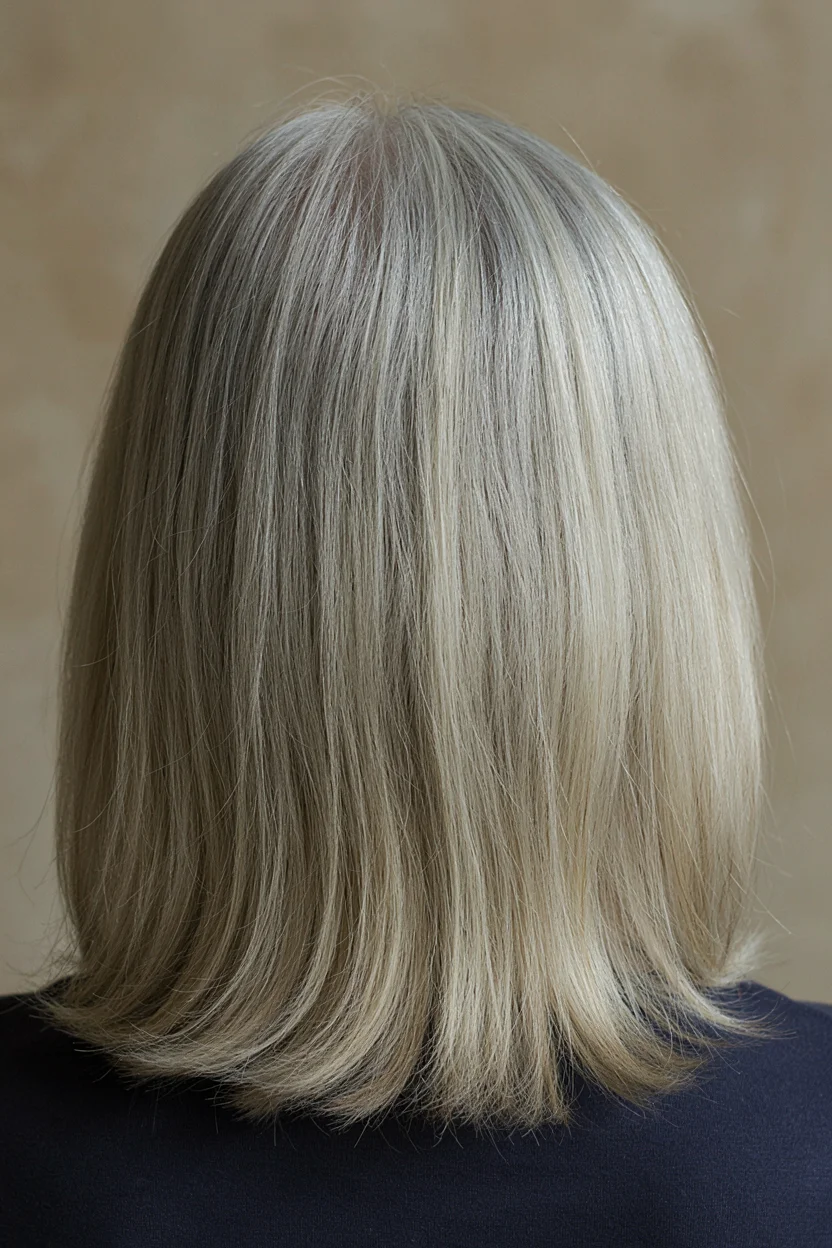
Hard water contains dissolved minerals, primarily calcium and magnesium, that deposit on the hair shaft during every wash. On pigmented hair, these deposits are largely invisible because the melanin masks the slight color shift. On silver hair, the mineral layer creates a warm, yellowish cast that becomes more pronounced with each successive wash.
If your water is hard, the yellowing will be most noticeable at the mid-length and ends, where the hair has been exposed to more washes and where the cuticle is more porous and absorbs more minerals. The root area, which is newer and has experienced fewer washes, will typically remain brighter.
| Yellowing cause | How to identify it | What works | How often | What does not work |
|---|---|---|---|---|
| Hard water minerals | Yellow cast worse at ends, improves briefly after clarifying wash | Chelating shampoo or shower filter | Chelating shampoo once every 2 weeks; filter is continuous | Purple shampoo alone, which addresses tone but not mineral deposit |
| UV exposure | Yellowing worse on the top and outer layers, better underneath | UV-protectant spray or hat coverage | Spray before outdoor time; hat as needed | Toning after the fact without preventing further UV damage |
| Product buildup | Yellowing accompanied by dull, heavy feeling; improves after clarifying wash | Clarifying shampoo rotation | Once a week or every other week | Adding more product on top of existing buildup |
| Environmental pollutants and smoke | Yellowing throughout, worse if exposed to smoke or pollution regularly | Clarifying wash plus environmental protection | Weekly clarifying; daily protection if exposure is ongoing | Purple shampoo as the only intervention |
A shower filter that reduces mineral content in the water is the most effective long-term solution for hard water yellowing. The filter attaches to the shower head and removes a significant percentage of calcium and magnesium before the water reaches your hair. The cost is roughly $30 to $60 for the filter unit, with replacement cartridges every three to six months at $15 to $25 each. A chelating shampoo used once every two weeks addresses the minerals that the filter does not catch.
I installed a shower filter in the second year of my transition, after I had been fighting yellowing with purple shampoo for months without understanding why the result never lasted. The filter resolved roughly seventy percent of the yellowing within three weeks. The remaining thirty percent was UV and product buildup, which required different solutions.
UV Exposure and Photoyellowing

Ultraviolet light degrades the protein structure of the hair surface and causes a chemical change in the keratin that produces a yellow tone. This process, called photoyellowing, affects all hair but is visible only on hair that lacks masking pigment. Silver and white hair shows the result clearly because there is no melanin to absorb or deflect the UV before it reaches the cortex.
Photoyellowing is most pronounced on the crown and outer layers of the hair, where UV exposure is most direct. The hair underneath, shielded by the top layers, typically remains brighter. If you notice that the yellow cast is concentrated on the top of your head and the hair near your part, UV is likely a primary cause.
Prevention is more effective than correction for UV yellowing. A UV-protectant spray applied before time outdoors creates a barrier that reduces ultraviolet light reaching the hair surface. A hat provides physical coverage for extended outdoor time.
Once UV yellowing has occurred, a purple shampoo or a violet-toned gloss can neutralize the yellow tone temporarily. However, if the UV exposure continues without protection, the yellowing returns within days.
Product Buildup
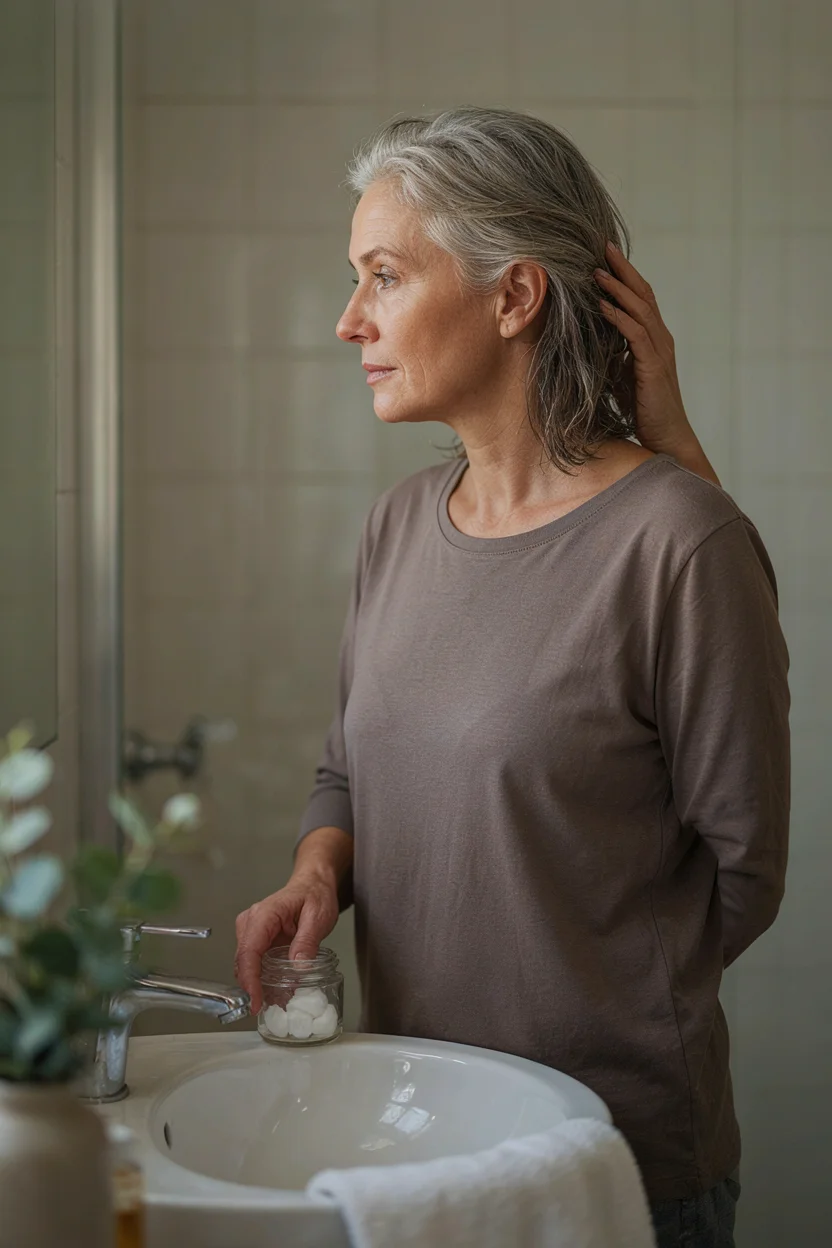
Styling products, conditioners, and even some shampoos leave residue on the hair shaft that accumulates over time. On silver hair, that residue often has a warm or yellowish tint that builds gradually until the overall tone shifts. The buildup is particularly common with products containing silicones, which coat the hair and trap environmental compounds.
The identification is straightforward: if the hair feels heavier than usual, looks dull, and the yellowing improves after a clarifying wash, product buildup is a factor. A clarifying shampoo used once a week or every other week removes the accumulated residue.
- If the yellow cast is worse at the ends and improves briefly after a chelating wash, hard water is the likely cause.
- If the yellowing concentrates on the crown and outer layers while the under-layers stay bright, UV exposure is the primary factor.
- If the hair feels heavy and dull and brightens noticeably after a clarifying shampoo, product buildup is responsible.
- If the yellowing is uniform throughout and you are regularly exposed to smoke or urban pollution, environmental pollutants are the cause.
Purple shampoo neutralizes yellow tone. It does not remove the thing that caused the yellow tone. Knowing the difference between those two sentences saves months of frustration.
I reduced product buildup by simplifying the number of products I used daily. Three products replaced the six or seven I had been applying, and the result was hair that stayed brighter between washes because there was less residue accumulating on the surface.
What Purple Shampoo Does and Does Not Do

Purple shampoo deposits a small amount of violet pigment onto the hair surface. Because violet and yellow are opposite each other on the color wheel, the violet pigment neutralizes the yellow tone and the hair appears brighter and more silver. The effect is temporary, lasting from one wash to the next, and it works on the symptom rather than the cause.
The limitations of purple shampoo are worth understanding before relying on it as the sole yellowing solution. It does not remove mineral deposits from hard water. It does not reverse UV damage to the keratin. It does not dissolve product buildup. It masks the yellow tone with a violet counter-tone, which is effective for maintaining brightness between washes but does not address why the yellow tone is present in the first place.
| Purple shampoo fact | Detail |
|---|---|
| Frequency of use | Once a week is sufficient for most silver hair; daily use risks over-depositing violet pigment |
| Application time | Three to five minutes on the hair before rinsing; longer application deposits more pigment |
| Over-deposit risk | Too-frequent use produces a purple or lavender cast that takes several regular washes to remove |
| Best use case | Maintaining brightness between clarifying washes, not as the primary yellowing treatment |
| Interaction with hard water | Less effective on mineral-coated hair because the violet pigment deposits on the mineral layer rather than the hair |
I used purple shampoo once a week as a maintenance step, not as a treatment. The actual yellowing in my hair required the shower filter, UV protection, and a reduction in product buildup. Once those causes were addressed, the purple shampoo kept the result bright between washes without needing to work harder than it was designed to.
Professional Toning and Glosses
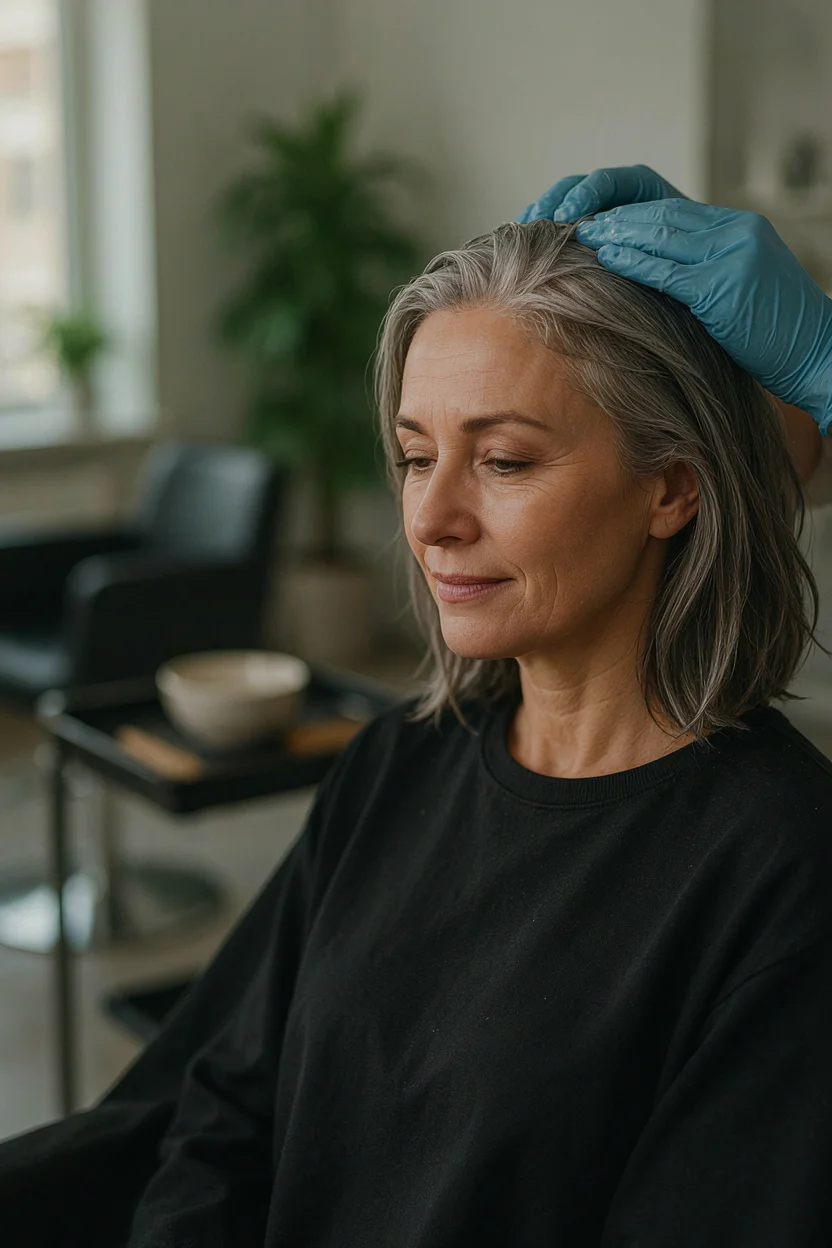
For women who want a more lasting tone correction than purple shampoo provides, a professional violet-based gloss or toner applied at the salon can neutralize yellowing for four to six weeks. The gloss deposits a semi-permanent violet tone that fades gradually with washing, providing a longer-lasting brightness than shampoo alone.
A salon gloss appointment typically takes thirty to forty-five minutes and costs $40 to $80 depending on the salon. The result is immediate and more uniform than at-home toning, because the stylist applies the product evenly across the entire head. A patch test is recommended before the first application, particularly for women with sensitive scalps or a history of reactions to hair products.
The gloss does not prevent yellowing from recurring. It corrects the tone for a period and then fades, at which point the underlying causes resume their effect. For women who have identified and addressed the primary cause of their yellowing, a gloss maintains the brightness between corrective measures. For women who have not identified the cause, the gloss fades and the yellow returns, which is why understanding the cause is the more durable approach.
Water Temperature and Washing Practices

Hot water opens the cuticle more than warm or cool water, which allows minerals, product residue, and environmental compounds to penetrate deeper into the hair shaft during washing. Washing silver hair with warm water rather than hot reduces the amount of deposit that accumulates with each wash. A cool rinse at the end of the wash closes the cuticle and creates a smoother surface that reflects light more evenly and resists deposit accumulation between washes.
The washing frequency also affects yellowing. Each wash in hard water deposits minerals, so washing less frequently reduces the total mineral accumulation over time. Two to three washes a week is the range most gray-hair specialists recommend, with a clarifying wash replacing one of those regular washes on a weekly or biweekly basis.
Distilled water rinses are occasionally suggested as a solution for hard water yellowing. They work, in the sense that distilled water contains no minerals to deposit. However, rinsing your hair with distilled water after every shower is impractical for most people, and a shower filter achieves a similar reduction in mineral exposure at a lower daily effort.
Frequently Asked Questions
Will purple shampoo fix all yellowing in my silver hair?
Purple shampoo neutralizes yellow tone on the surface of the hair, but it does not remove the underlying cause. If the yellowing is caused by hard water minerals, UV damage, or product buildup, purple shampoo will mask the tone temporarily while the cause continues to deposit yellow compounds. Identifying and addressing the cause produces a more lasting result than relying on purple shampoo alone.
How often should I use purple shampoo on silver hair?
Once a week is sufficient for most silver hair. Using purple shampoo more frequently risks over-depositing violet pigment, which gives the hair a purple or lavender cast. That cast takes several washes with regular shampoo to remove. A weekly application maintains brightness without creating a new color problem.
Can hard water permanently stain silver hair?
Hard water deposits are not permanent in the sense that they cannot be removed. A chelating shampoo or a professional clarifying treatment removes the mineral buildup. However, if hard water is the ongoing cause and no filter or preventive measure is used, the deposits return with each wash. The yellowing is reversible, but the recurrence is continuous until the water source is addressed.
Does chlorine in pool water turn silver hair yellow?
Chlorine can deposit on silver hair and contribute to a yellowish or greenish cast, particularly in pools with high chlorine levels or copper-based algaecides. Wetting the hair with clean water before entering the pool reduces chlorine absorption, because the hair absorbs less pool water when it is already saturated. A clarifying wash after swimming removes chlorine deposits before they accumulate.
Why does my silver hair look more yellow in photographs than in the mirror?
Camera sensors and lighting conditions render warm tones more prominently than the human eye does in real time. Indoor lighting, particularly incandescent or warm LED, adds a yellow cast that the camera captures more faithfully than your eye adjusts for. The hair may look more yellow in photographs because the camera is showing the warm tones that your brain filters out during everyday vision. This is worth knowing before concluding from a photograph that the yellowing is worse than it appears.
The Cause Before the Correction
Silver hair turns yellow for identifiable reasons, and each reason has a practical solution. The yellow cast is not a sign that silver hair is failing. It is a sign that the environment is depositing color on a fiber that no longer has melanin to shield it. Address the cause, maintain the brightness with a weekly toning wash, and the silver stays closer to the color it grew in as.
— Nora