Hair Growth Cycle: How It Actually Works
I used to picture my hair growing on one shared timeline, all of it advancing together, until I read that every single follicle runs its own independent clock, and that reframed almost everything confusing about shedding, regrowth, and why a “six-month growth challenge” was never going to work the way the ads implied. The hair growth cycle is the repeating sequence each follicle moves through — a long growing phase, a short transitional phase, and a resting phase that ends in shedding — and because every follicle is on its own clock, a healthy scalp always has some hairs growing, some resting, and some falling out at the exact same time. Understanding that overlapping structure is the single most useful piece of hair biology for making sense of everything else in this category, from why growth oils can’t work faster than they do to when ordinary shedding actually crosses into something worth a dermatologist visit.
The hair growth cycle has three main phases — a multi-year growing phase, a short transitional phase, and a resting phase that ends in normal shedding — and because follicles cycle independently, healthy hair is always shedding a little while other strands are growing.
The Three Phases of the Hair Growth Cycle
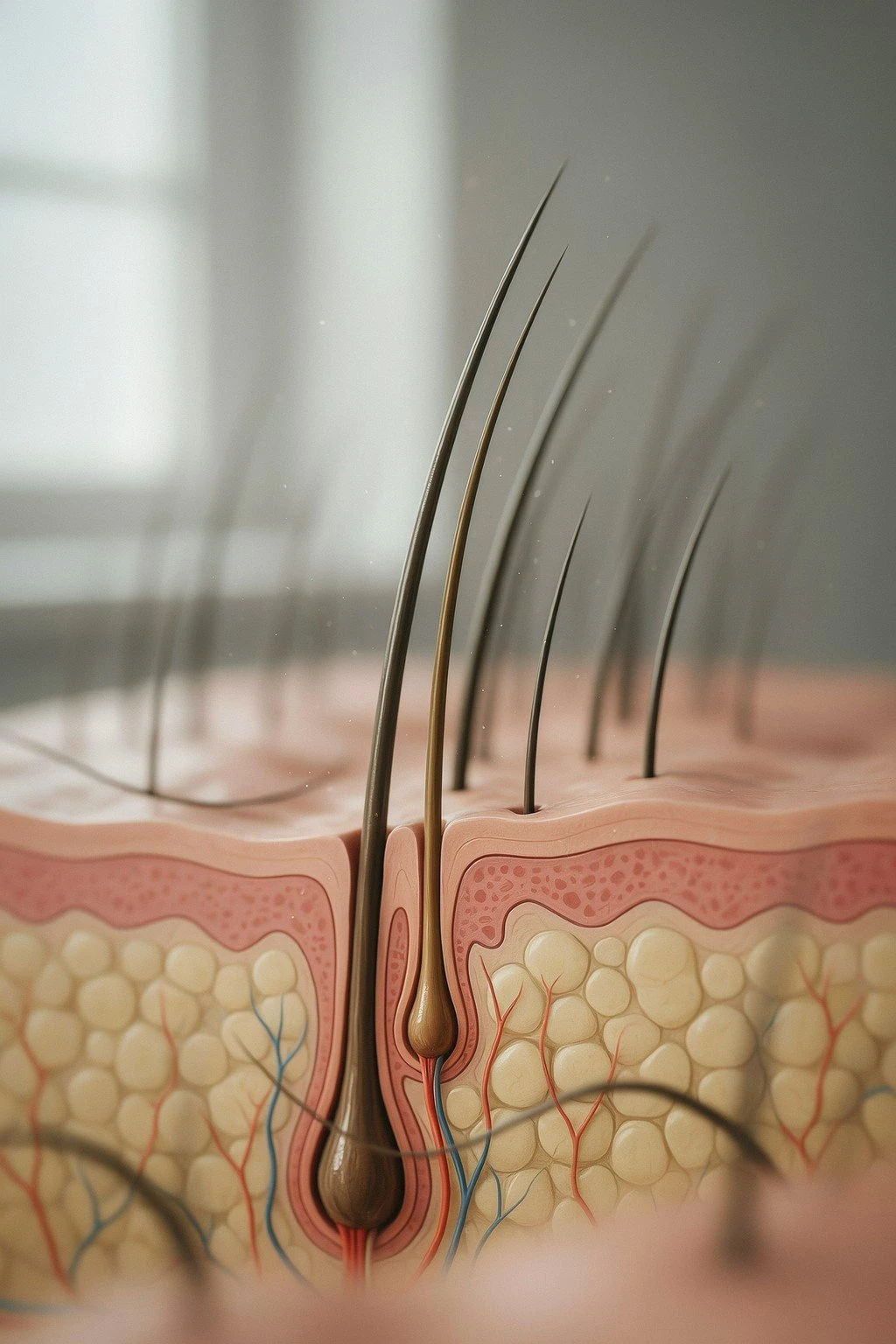
Anagen is the active growing phase, when the follicle is producing new hair steadily, and it’s by far the longest phase, typically running somewhere between two and seven years depending on genetics — this is also the phase that sets your hair’s maximum possible length, since hair simply stops growing once a strand’s anagen phase ends, regardless of how long you wait afterward. Catagen is a short transitional phase, usually lasting only a few weeks, during which the follicle shrinks and detaches from its blood supply, effectively signaling that active growth is winding down. Telogen is the resting phase, typically lasting a few months, during which the strand sits inactive in the follicle before eventually being shed to make way for a new anagen strand underneath it — some classifications add a distinct exogen phase for the shedding moment itself, but functionally it’s the tail end of telogen doing the same job.
What makes this genuinely counterintuitive the first time you learn it is that these three phases aren’t happening to your hair as a whole — they’re happening independently, follicle by follicle, across your entire scalp at once. A strand near your temple might be three years into a five-year anagen phase while a strand at your crown just entered telogen last week, and neither one has any bearing on the other’s timeline. That independence is precisely why a healthy head of hair looks stable day to day despite constant, continuous turnover underneath — if every follicle were synchronized instead, hair would visibly grow and shed in dramatic waves rather than the steady, unremarkable pattern most people actually experience.
How Long Each Phase Actually Lasts
| Phase | What’s happening | Typical duration |
|---|---|---|
| Anagen (growing) | Active production of new hair | 2–7 years |
| Catagen (transitional) | Follicle shrinks, detaches from blood supply | 2–3 weeks |
| Telogen (resting) | Strand sits inactive before shedding | 2–4 months |
At any given time, roughly 85 to 90 percent of the hair on a typical scalp is in anagen, a small percentage is in catagen, and the rest, usually somewhere around 10 to 15 percent, is in telogen and approaching its natural shed. That distribution is what makes daily shedding of somewhere around 50 to 100 hairs a completely normal, expected part of a healthy cycle rather than a sign anything is wrong — it’s simply telogen-phase hairs completing their cycle on schedule while other follicles are mid-anagen and not going anywhere.
Age gradually shifts this balance in a way most people don’t notice until it’s already underway — the percentage of follicles in active anagen at any given time tends to decline slowly over decades, and individual anagen phases themselves tend to shorten somewhat, which is part of the ordinary biology behind why maximum achievable hair length and overall density can both trend downward gradually with age even without any specific medical condition driving it. This is a slow, population-level pattern rather than something that predicts any individual’s exact experience, but it’s a useful piece of context for understanding why a routine that worked at twenty five doesn’t always produce the same result decades later.
What Actually Influences the Cycle
Genetics sets the baseline length of anagen for each person, which is the single biggest reason some people seem to grow hair to dramatic lengths with no special effort while others plateau at a shorter maximum regardless of routine — both are the cycle working normally, just calibrated differently. Hormonal shifts, particularly around pregnancy, postpartum, and thyroid changes, can push a larger-than-usual share of follicles into telogen at once, which is the mechanism behind the noticeably heavier shedding some people experience in those specific situations, typically resolving on its own as the cycle rebalances over the following months. Nutritional deficiencies, particularly in iron and protein, can also shorten anagen or push follicles toward telogen prematurely, which is one of the few genuinely evidence-backed reasons a blood panel is sometimes a more useful next step than another product change.
What Does Not Meaningfully Speed This Up
This is the section most growth marketing skips, and it’s worth being direct about:
- Topical oils and scalp massages do not extend anagen or shorten telogen in any way that’s been reliably demonstrated at consumer-product concentrations.
- Trimming, contrary to a persistent myth, has no effect on the growth rate happening at the follicle, since the two locations aren’t connected in any way that would let one influence the other.
- Brushing a fixed number of strokes a day does not stimulate additional growth beyond whatever mild, temporary circulatory effect any scalp massage provides.
- Vitamins and supplements taken without an actual deficiency present do not meaningfully speed up a cycle that isn’t being limited by that nutrient in the first place.
What can genuinely help is addressing an actual limiting factor — a real deficiency, an underlying hormonal or thyroid issue, chronic breakage that’s disguising healthy growth as slow growth — rather than trying to accelerate a cycle that’s already running at its normal, genetically set pace. A lot of what gets marketed as growth support is really breakage prevention wearing a growth claim, which is a legitimate and worthwhile thing to buy, just not the thing the label says it is.
No product changes how long anagen lasts. What most of them actually do is keep the hair you already have from breaking off before it gets there.
Normal Shedding vs. a Cycle Disruption

A hair with a small white or translucent bulb at the root, found on your brush or in the shower drain, is simply a telogen-phase strand that completed its cycle on schedule — the bulb is normal follicle tissue, not a root being torn out, and finding several of these on an ordinary day is expected rather than alarming. What’s worth paying attention to instead is a real change in volume or pattern: noticeably more hair than your personal normal for several consecutive weeks, thinning concentrated at the part or hairline rather than spread evenly, or hair coming out with force rather than after gentle brushing. If you’re consistently shedding well beyond the roughly 100 hairs a day considered typical, or noticing visible thinning at the part or hairline that persists for more than a few months, that’s a concrete threshold worth bringing to a dermatologist rather than waiting to see if it resolves on its own — a dermatologist can identify whether the cause is hormonal, nutritional, autoimmune, or genetic in a way no amount of self-diagnosis from a mirror can.
Realistic Timelines for Growth
Scalp hair grows at an average rate of roughly half an inch per month, which works out to around six inches a year under ideal conditions — a number that sounds modest next to most growth marketing, but is the honest, measured average across healthy anagen-phase hair. Because that rate is set by the follicle and not meaningfully adjustable by any topical product, the most reliable way to see visibly longer hair faster is indirectly: reducing breakage so more of what’s growing actually stays on your head, rather than expecting the growth rate itself to change. Three to four months is the minimum realistic window to judge any routine change against this cycle, since that’s roughly how long it takes for a shift at the follicle level to become visible at the ends, and anyone promising a dramatically faster timeline is describing marketing, not biology.
It’s worth separating two things people often lump together under “growth”: actual new production at the follicle, and simple retained length from reduced breakage. A change in routine that visibly adds length within six to eight weeks is almost certainly the second thing — hair that was already there and would have broken off is now staying on, which reads as faster growth even though the follicle’s own output hasn’t sped up at all. Both outcomes are worth having, and it’s honestly the more achievable one, but they’re not the same claim, and knowing which one a given product is actually delivering keeps expectations realistic rather than disappointed at the four-month mark.
Frequently Asked Questions
How many hairs are normal to lose in a day?
Somewhere between 50 and 100 hairs a day is the commonly cited normal range, reflecting the small percentage of follicles completing telogen on any given day. Counting exactly isn’t necessary — a noticeable, sustained increase over your personal normal, rather than a single heavier day, is the more useful signal to track.
Can stress really affect the hair growth cycle?
Yes — significant physical or emotional stress can push a larger share of follicles into telogen earlier than they otherwise would have, a pattern generally recognized to show up roughly two to three months after the stressful event rather than immediately. This kind of shedding typically resolves on its own over several months as the cycle rebalances, though a dermatologist visit is reasonable if it doesn’t.
Does the growth cycle run faster in summer than winter?
There’s a mild seasonal pattern some research points to, with growth trending slightly faster in warmer months, though the difference is small relative to the roughly half-inch-per-month average and isn’t something most people would notice without careful measurement. Genetics and overall health have a far larger effect on your actual growth rate than the season does.
How long does telogen effluvium last?
Diffuse shedding tied to a temporary telogen shift typically peaks within a few months of the triggering event and then eases as the cycle rebalances, often resolving within six to nine months overall. If heavier shedding continues well beyond that window, that’s a reasonable point to see a dermatologist rather than continue waiting it out.
Why does hair grow back a different texture sometimes?
The follicle itself can shift shape slightly between growth cycles due to hormonal changes, illness, or simple aging, which changes the texture of the strand it produces even though the underlying growth mechanism hasn’t changed. This is a normal, if sometimes surprising, part of how the cycle works over a lifetime rather than a sign of damage.
What to Actually Track Instead of Guessing
Skip the growth challenges promising results in weeks, and instead give any real routine change a genuine three to four months before judging it, since that’s the timeline the cycle itself actually runs on. A monthly photo in the same light tells you more than daily worrying ever will.
If you’re noticing a change that doesn’t match what’s described here, tell me in the comments — I’ll help you figure out whether it’s worth a dermatologist visit. — Iris