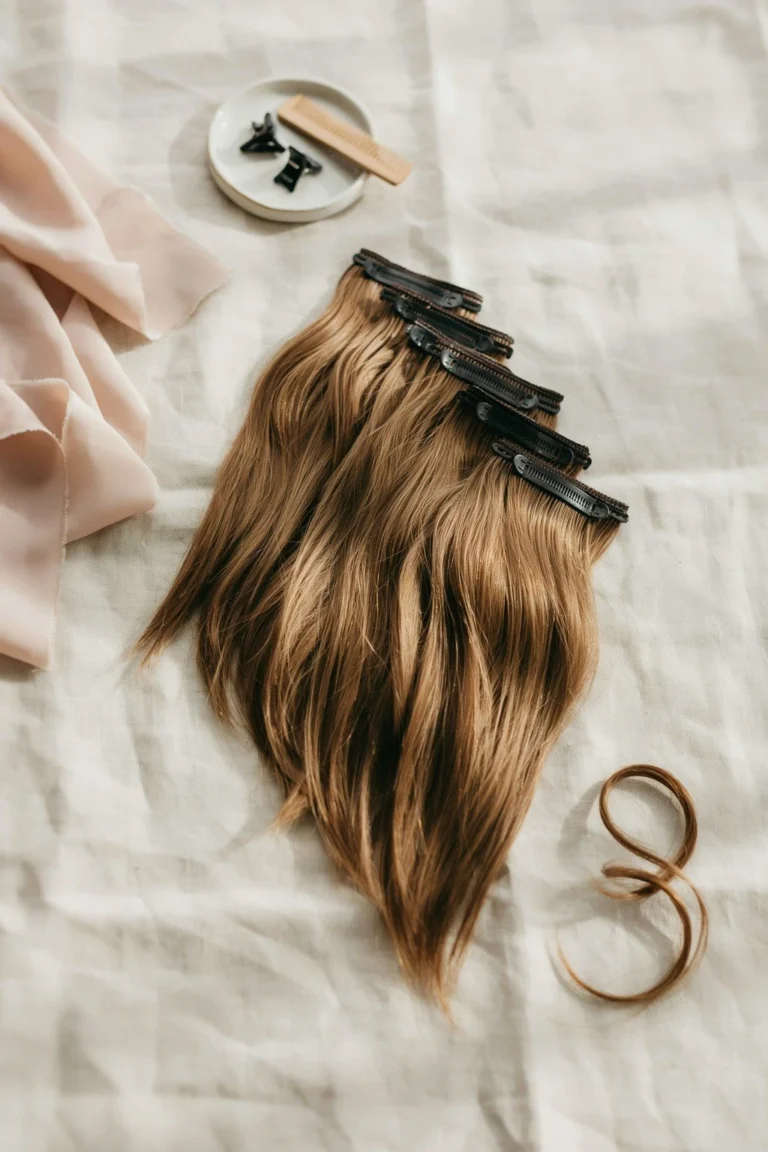
Human Hair Extensions: What You’re Actually Paying For

Human hair extensions get sold with the implication that they’re simply the better option, full stop, and that’s not quite honest. They cost three to five times what synthetic fiber costs, and that premium buys something real, but it’s a trade-off suited to specific situations, not a universal upgrade everyone needs. I’ve fitted both for clients who were thrilled with each, and the deciding factor was never which one is “better” — it was which one matched how they’d actually use it.
I wear my own hair short and unextended, which is admittedly a strange thing for someone in this job, but it’s also why nothing here is written to push you toward the pricier option. My interest is in whether you actually get your money’s worth from whichever one you choose, not in which one costs more.
Human hair extensions cost significantly more than synthetic fiber because they can be heat-styled, colored within limits, and last considerably longer, but that premium is only worth paying if you’ll actually use those specific advantages.
What the Price Difference Actually Buys
| Factor | Human hair | Synthetic |
|---|---|---|
| Heat styling | Yes, standard tools | Only if labeled heat-friendly |
| Typical lifespan | 1–2 years | 4–6 months |
| Typical price | $150–$400+ | $30–$100 |
| Styling effort | Styles and restyles like your own hair | Holds a pre-set style only |
| Blending in motion | Very natural | Good, slightly less natural |
Notice that synthetic isn’t simply “worse” across every row — it wins on upfront cost and needs zero daily styling effort, which is a genuine advantage for anyone who wants a grab-and-go option. Human hair wins on longevity and flexibility, which matters more if you’re wearing a piece regularly and want it to behave like an extension of your actual routine rather than a separate object.
Cost per wear is a more useful comparison than sticker price alone, and it’s worth actually doing the math before assuming synthetic is automatically cheaper. A $70 synthetic set worn twice a week and replaced every five months works out to roughly the same per-wear cost as a $250 human hair set worn the same amount and replaced once every eighteen months. The math shifts further in human hair’s favor the more often you wear it, and shifts toward synthetic the less often you do.
Where Human Hair Actually Comes From
Quality human hair extensions are sourced from donors, collected in a way that keeps the cuticle layer intact and aligned in one direction — this is called Remy hair, and it’s the reason good human hair doesn’t tangle and mat the way lower-quality or non-Remy hair does. Non-Remy hair, where cuticles run in mixed directions, is cheaper but tangles faster and has a shorter usable life even though it’s technically still “human hair.” The label alone doesn’t tell you which you’re getting — ask specifically whether a set is Remy, and be skeptical of a very low price paired with a Remy claim.
Origin is worth asking about too, since it affects both texture and price. Hair sourced and processed with minimal chemical treatment tends to be labeled “virgin,” meaning it hasn’t been permed, colored, or otherwise processed before collection. Virgin hair costs more and holds up to styling better than hair that’s already been through processing once, since it’s starting from a stronger, less compromised structural baseline. Not every set needs to be virgin quality — it depends again on how much heat and handling you’re planning to put it through.
Can You Color Human Hair Extensions?
Within limits. A colorist can adjust the tone of human hair extensions, deepening or toning a shade closer to your own hair. What they can’t do is lift it significantly lighter the way they’d lighten your own growing hair, since extensions don’t have a living root feeding new pigment and the hair has already been processed once during manufacturing. This is shade matching, not shade changing — if you need extensions several levels lighter than what you’re holding, that’s a different order, not a color service on the set you already own.
A colorist working on extensions off your head, rather than while they’re installed, has more control and less risk of uneven results, though both approaches are used depending on the method. If you’re getting a worn-in set colored while installed, that’s a longer, more careful appointment than a standard color service, and it’s worth budgeting the extra time and cost that implies.
Human hair extensions aren’t simply better hair. They’re a different set of trade-offs, and the price only makes sense if you’re actually using what it buys.
The Honest “Don’t”
If you’re buying extensions for a single event or occasional wear a few times a year, a quality synthetic set is the more sensible purchase — you won’t use enough of human hair’s heat-styling flexibility or longevity to justify the price difference, and a synthetic set held for a special occasion doesn’t need to survive a year of regular wear anyway.
The reverse honest answer holds too: if you’re wearing extensions several times a week and finding yourself replacing a synthetic set every few months, you’re likely spending more over a year than a single human hair purchase would have cost, on top of dealing with fiber that degrades faster and can’t take the heat styling you might actually want. Frequency of wear is the single best predictor of which side of this decision you should land on.
How to Make Human Hair Extensions Last
- Wash every 15 to 20 wears with a sulfate-light shampoo, not more frequently than needed.
- Use heat protectant every time you style with hot tools, exactly as you would on your own hair.
- Store on a wig stand or hanger between wears to prevent tangling and matting.
- Deep condition occasionally, since the hair no longer has a scalp producing natural oils to replenish it.
- Detangle from the ends upward with a wide-tooth comb, never starting at the root on dry hair.
None of this care routine needs to be complicated or expensive. Most of it is the same basic care your own hair benefits from, applied a bit more deliberately since extensions don’t have a scalp replenishing moisture and oils the way growing hair does.
Frequently Asked Questions
How can I tell if human hair extensions are actually Remy quality?
Ask the seller directly and look for it explicitly stated, since it’s not always obvious from a product photo. A quick test once you have the hair in hand: run your fingers down a section from tip to root — Remy hair feels smooth in that direction and rougher going the other way, since the cuticles all face one direction. Non-Remy hair feels roughly the same in both directions, since the cuticles are mixed rather than aligned.
Do human hair extensions look more natural than synthetic?
Generally yes, especially in motion and under changing light, since human hair reflects and moves closer to how your own hair does. A good-quality synthetic set can still look convincing while still, but the difference tends to show more once you’re actually moving through your day.
Can I swim or exercise in human hair extensions?
Clip-in and halo methods can be removed before swimming or intense exercise, which is the simplest way to protect them. Worn-in methods using human hair generally tolerate light activity fine, though chlorine and saltwater both dry the hair out faster than fresh water and are worth rinsing out promptly afterward.
Why do some human hair extensions cost so much more than others?
Sourcing quality, whether the cuticle is intact and aligned, and how much processing the hair went through before sale all affect price significantly. A very cheap “human hair” listing is more likely to be lower-grade or non-Remy hair than genuinely premium material, regardless of the label.
Is it worth mixing human hair and synthetic in one set?
Some blended sets do this deliberately to balance cost against styling flexibility, and it can be a reasonable middle ground. Just know the synthetic sections still won’t tolerate full heat styling even though the set overall costs more than pure synthetic.
How do I avoid buying mislabeled or lower-quality human hair?
Buy from a seller willing to answer specific questions about sourcing and Remy status rather than one using vague marketing language alone. A price significantly below the typical range for the claimed quality is the clearest warning sign, and it’s worth trusting that instinct over an appealing photo.
Deciding If It’s Worth It
Be honest about how often you’ll actually wear a piece and whether you’ll use the heat-styling flexibility before you pay the premium. That answer matters more than which option photographs better.
Tell me how often you’d wear extensions and whether heat styling actually matters to you, and I’ll help you decide if the human hair premium makes sense for you. — Della