Clip-In Hair Extensions: What to Know Before You Buy
Clip-in hair extensions get sold as the simple, no-risk option, and they mostly are, but “simple” doesn’t mean the weight and placement decisions don’t matter. I’ve fitted enough of these to know the difference between a set that blends invisibly and one that reads as obviously added comes down to a handful of choices made before you ever clip anything in. This covers what actually decides whether a set works for your hair, not just how to put it in.
I wear my own hair short and unextended, which people find a little funny given my job, but it means I have no stake in talking you into a bigger set than you actually need. My only interest here is whether whatever you buy holds up to real wear — sleeping, tying it back, a full day at your desk — not whether you buy the most expensive option available.
Clip-in hair extensions are the lowest-commitment method available, applied and removed daily with no professional appointment or ongoing wear-window to manage, but weight and placement still decide whether the result actually blends.
How Clip-Ins Actually Work
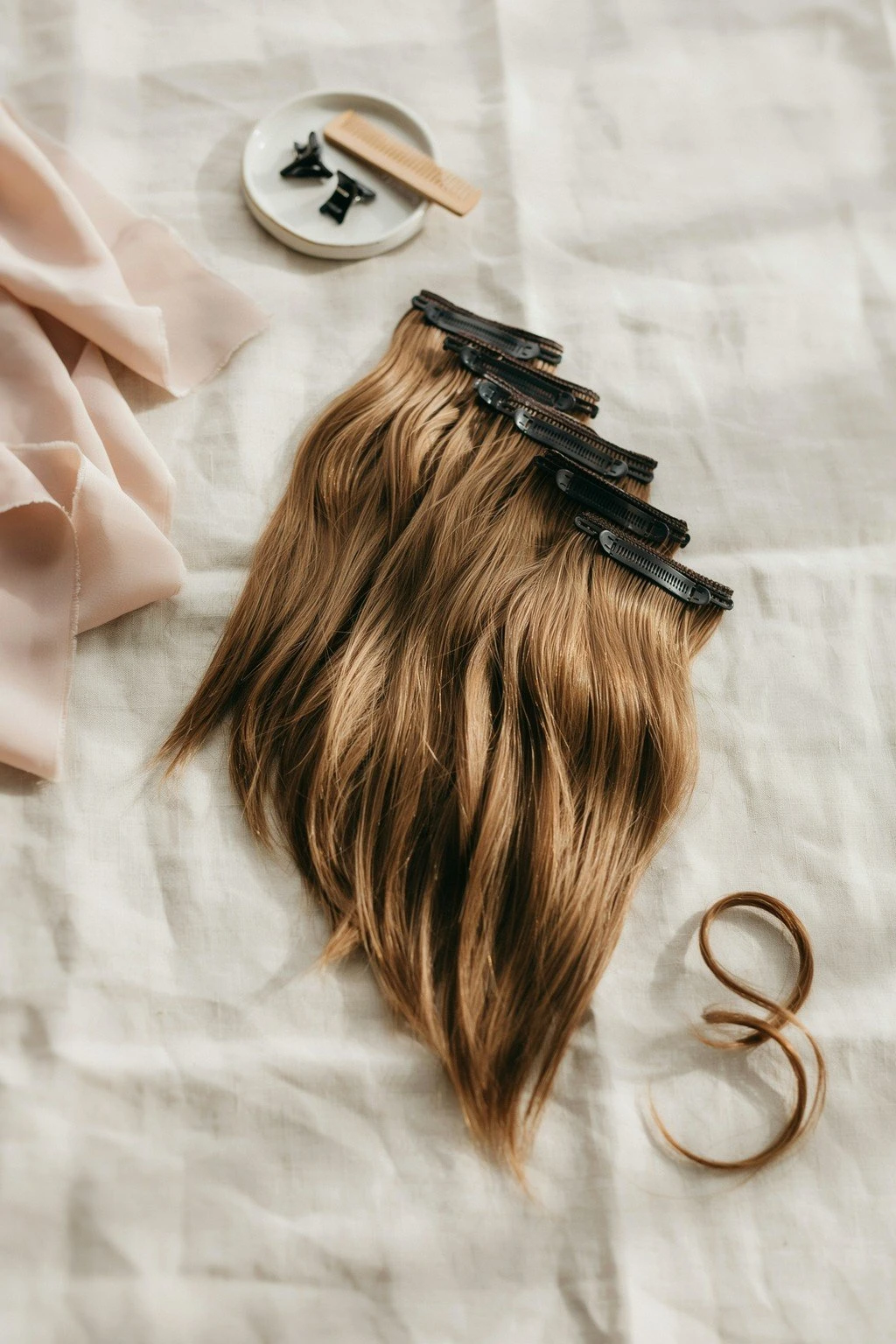
Small pressure clips sewn into a fabric weft grip sections of your own hair when clamped shut, holding the extension in place until you unclip it. Because nothing is adhered, sewn, or bonded, there’s no wear window to manage and no professional removal required — the entire method exists specifically to avoid the ongoing commitment that tape, sew-in, and bond methods carry. That’s the trade: daily application effort in exchange for zero standing tension between wears.
The clips themselves come in a few different styles worth knowing about. Snap clips are the standard, flat metal pieces most sets use, gripping firmly with minimal bulk. U-shaped clips distribute grip slightly differently and some people find them more comfortable on a sensitive scalp. Comb clips, less common now, use small teeth rather than a snap mechanism and tend to be the least secure of the three for active wear.
Weight Before Length
The instinct is to ask how much length a set adds. The more useful question is how much it weighs, since that’s what your own hair actually has to support for the hours you’re wearing it. A set that’s too heavy for your density pulls visibly at the roots and feels uncomfortable by the end of the day, regardless of how good the length looks in a mirror at 9am.
| Hair density | Recommended weight | What happens if you go heavier |
|---|---|---|
| Fine | 80–110g | Visible pulling at the part, discomfort by afternoon |
| Medium | 110–150g | Manageable, but watch for crown tension |
| Thick | 150–200g | Usually well tolerated at this density |
These are starting points, not fixed rules — your own comfort over a full day of wear is the real test, and it’s worth sizing down from what you think you want rather than up.
Where you place the heaviest wefts matters as much as the total weight. The crown and the area right at the back of the head, above the nape, generally tolerate more weight comfortably than the temples and the hairline do, since the hair there is typically denser and the skin less sensitive. A well-designed set distributes weight with this in mind, using narrower, lighter wefts near the face and the heaviest pieces toward the center back.
Applying a Clip-In Set
- Section hair horizontally, starting near the nape, and clip the rest up out of the way.
- Backcomb the section very lightly at the root for grip, then open the weft’s clips and press them flat against the scalp, snapping shut.
- Release the next section down and repeat, working upward toward the crown.
- Blend your own top layer over the topmost weft to hide the clip line.
This is a consumer product designed for you to fit yourself, unlike tape, sew-in, or bond methods, which need a professional. Most people take ten to fifteen minutes to get comfortable with the process and considerably less once it’s routine.
A few small details separate a set that looks fitted from one that looks added. Curling or waving the very top layer of your own hair to match the extension’s texture, rather than leaving your own hair flat, does more to blend the two than an exact color match alone. And working from the bottom sections up, rather than starting at the crown, means any small placement error ends up hidden under later layers instead of left visible on top.
The weight you can wear comfortably for eight hours is the only number that matters. Everything else about a set is secondary to that.
How Long a Set Actually Lasts
Synthetic clip-ins typically last 4 to 6 months of regular wear, around $60 to $150 depending on quality, before the fiber starts tangling and dulling beyond what washing fixes. Human hair clip-ins cost considerably more, generally $150 to $350, but last a year or more with proper care, since the hair can be washed, conditioned, and occasionally heat-styled like your own.
Lifespan also depends heavily on how the set is actually treated between wears, not just its fiber type. A synthetic set stored properly on a stand and detangled gently will outlast a human hair set that’s balled up in a bag and brushed roughly, even though the fiber type alone would suggest the opposite. Care habits and fiber quality both matter, and neither one fully compensates for neglecting the other.
Removal Is the Easy Part
Unclipping is quick and requires nothing beyond your own hands — this is the one method on the site where removal genuinely is as simple as it sounds. There’s no solvent, no professional appointment, and no residue to manage. That said, remove a set every night rather than sleeping in it; the clips can tangle badly overnight and put uneven pressure on the hair underneath while you sleep.
If a clip does snag badly in your own hair during removal, stop and work it loose slowly rather than pulling straight through. A few strands caught in the mechanism is common and not a sign anything went wrong, but yanking a stuck clip out under tension is exactly the kind of moment that causes more breakage than the entire rest of a day’s wear.
The Honest “Don’t”
Wearing the exact same set clipped into the exact same sections every single day, for months on end, is still a form of repeated tension even though clip-ins are removable — the follicles at those specific attachment points never get a real break. Rotate your clip placement slightly between wears, and if you notice any tenderness at a specific spot, skip clipping there for a while rather than pushing through it.
Care Between Wears
- Store on a wig stand or hanger, not balled up in a drawer, to prevent tangling.
- Wash human hair sets every 15 to 20 wears with a sulfate-light shampoo; synthetic sets need washing less often, roughly every 25 to 30 wears.
- Detangle gently from the ends upward before storing, never while wet if synthetic.
- Keep heat tools away from synthetic fiber entirely unless it’s specifically labeled heat-friendly.
- Let sets air dry fully before storing to prevent mildew or an unpleasant smell developing in the weft.
A small routine goes a long way here. I keep a soft-bristle brush dedicated only to my extensions, separate from what I use on my own hair, since product buildup and shed hair from daily brushing transfer between the two otherwise. It’s a small habit, but it noticeably extends how long a set looks fresh.
Frequently Asked Questions
How many wefts come in a standard clip-in set?
Most full-head sets include 6 to 8 wefts of varying widths, from a wide back piece to narrow side pieces. Partial sets for volume or face-framing only may include just 1 to 3 pieces.
Can clip-in extensions damage my hairline?
Low risk if weight suits your density and placement rotates between wears, but wearing the same heavy set in the same spot daily for months can contribute to tension at that specific point. Give your hairline breaks and watch for any tenderness.
How do I match the color of clip-in extensions to my hair?
Order swatches when available rather than matching from a screen, and check the match in natural daylight against clean, product-free hair. Many sets come in multi-tonal blends specifically to account for natural color variation rather than one flat shade.
Do clip-in extensions work on very fine hair?
Yes, with the right weight — stick to the lighter end of the recommended range and consider a set with narrower wefts and finer clips designed specifically for fine hair, which distribute weight more evenly than standard clips. Sizing down and choosing more, thinner wefts over fewer, wider ones generally gives fine hair a more secure, comfortable hold.
Is it worth buying human hair clip-ins over synthetic?
It depends on how often you’ll wear them and whether heat styling matters to you. Human hair costs more upfront but lasts longer and blends more naturally in motion; synthetic is cheaper and requires no styling but needs replacing sooner and can’t take heat.
How long does it realistically take to get quick at applying clip-ins?
Most people go from fifteen or twenty minutes on the first few tries down to five minutes or less within a couple of weeks of regular practice. The learning curve is mostly about muscle memory for sectioning consistently, not a technique that requires ongoing skill once it clicks.
Before You Order a Set
Know your density and pick a weight honestly suited to it before you look at length or color. That single decision does more for how natural the result looks than anything else on this page.
Tell me your density and how often you’d realistically wear a set, and I’ll help you land on the right weight and fiber. — Della