Dandruff or Scalp Psoriasis? The Scale and Itch Clues

I once heard someone describe years of treating what she believed was stubborn dandruff before a dermatologist identified scalp psoriasis in a single examination. The flaking had been present for most of her adult life, and every anti-dandruff shampoo she tried had produced the same result: temporary, partial relief followed by the same flakes returning within days. The question of whether you are dealing with dandruff or scalp psoriasis is one of the most common points of confusion in scalp care, and the answer changes everything about how you approach treatment.
The most reliable visual distinction between dandruff and scalp psoriasis lies in the scale itself. Dandruff produces fine, white or yellowish flakes that shed loosely from the scalp and are often visible on the shoulders. Scalp psoriasis produces thicker, silvery-white scales that sit on top of raised, well-defined patches of skin, and these patches frequently extend beyond the hairline onto the forehead, behind the ears, or at the nape of the neck. If your flaking has not responded to four weeks of consistent anti-dandruff treatment, the likelihood increases that you are treating the wrong condition, and a dermatologist visit is the step that clarifies what is actually on your scalp.
The Scale Pattern: What the Flakes Look Like Up Close
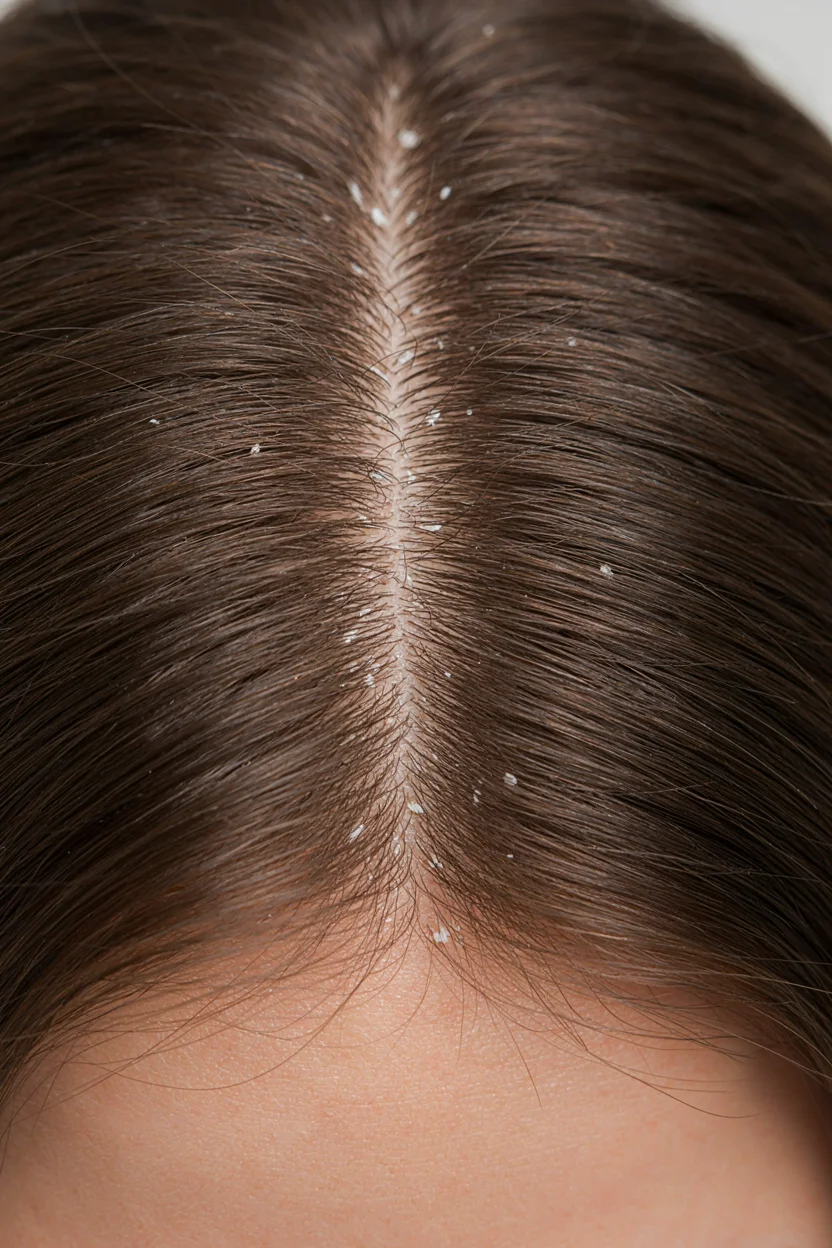
Dandruff flakes are typically small, thin, and either white or faintly yellowish. They detach from the scalp easily and are often found scattered through the hair and on the shoulders beneath it. The flakes are produced when the scalp skin turns over more quickly than normal, shedding corneocytes, the dead cells of the outermost skin layer, before they have fully matured and separated. This accelerated turnover is often associated with the yeast species Malassezia, which lives on everyone’s scalp and appears to trigger irritation in some people, particularly when sebum production is higher.
Scalp psoriasis scales are structurally different. They are thicker, more adherent to the skin surface, and have a distinctive silvery-white appearance that comes from the dense accumulation of immature skin cells. Psoriasis speeds up skin cell turnover so that new cells reach the surface in roughly three to four days instead of the usual month, and the cells pile up on the surface before they have time to separate and shed individually. The result is a raised, well-demarcated plaque with a scale on top that you can feel as a distinct ridge when you run your fingers over it. The scale does not shed as loose flakes; it comes away in thicker pieces, sometimes with slight pinpoint bleeding beneath if removed.
Where Can You Research How Psoriasis Changes Skin Turnover?
| Source | What It Says |
|---|---|
| Cleveland Clinic: Scalp psoriasis | Explains that in scalp psoriasis new skin cells reach the surface in about three to four days rather than the usual month, causing thick, scaly plaques. |
| National Psoriasis Foundation: Scalp psoriasis | Describes how scalp psoriasis looks, where it tends to appear (including past the hairline and behind the ears), and the treatment options a dermatologist may use. |
| National Psoriasis Foundation: About psoriasis | Background on psoriasis as an immune-mediated condition. It explains why the condition is not contagious and why it can affect the elbows, knees and nails as well as the scalp. |
The first time I saw scalp psoriasis up close, I understood immediately why the person had been treating it as dandruff for years. The silvery scale looks, at a casual glance, like concentrated dandruff, and the instinct is to reach for a stronger anti-dandruff shampoo. The distinction becomes clear when you look at the edges of the affected area: psoriasis plaques have sharply defined borders where the affected skin meets normal skin, while dandruff produces a more diffuse flaking that does not form discrete patches.
Where on the Scalp Each Condition Tends to Appear

Dandruff tends to appear across the scalp in a relatively diffuse pattern, without forming well-defined patches. It is often most noticeable on the crown and along the part line, where sebum accumulates and Malassezia populations are highest. The flaking may be accompanied by mild redness, but the skin beneath the flakes generally looks normal rather than raised or inflamed. Dandruff does not typically extend beyond the hairline onto the face or neck, though the related condition seborrhoeic dermatitis can affect the eyebrows, the sides of the nose, and the area behind the ears.
Scalp psoriasis has a different geographical preference. It tends to concentrate at the hairline, particularly the frontal hairline and the area behind the ears, and at the nape of the neck where the scalp meets the upper back. The patches are well-defined and may extend visibly beyond the hairline onto the forehead or the skin behind the ears, which is one of the most reliable location-based clues. If the flaking you see crosses the boundary from scalp to face or neck skin, psoriasis becomes a more likely explanation than dandruff.
Psoriasis also frequently appears on other parts of the body, which provides a useful cross-reference. The elbows, knees, and nails are common sites, and if you have psoriasis patches elsewhere, the probability that your scalp flaking is psoriasis rather than dandruff increases considerably. I have noticed that most people describe their scalp flaking as dandruff by default, and the distinction between the two conditions rarely enters the conversation until something does not respond to treatment as expected.
How the Itch Differs Between the Two

Both dandruff and scalp psoriasis can produce itch, but the quality and intensity tend to differ. Dandruff itch is typically mild to moderate, a surface-level irritation that comes and goes and is often described as a tickling or crawling sensation rather than a deep itch. It tends to worsen when the scalp is dry or when product buildup accumulates between washes, and it may improve temporarily after washing with a gentle shampoo.
Scalp psoriasis itch tends to be more intense, more persistent, and sometimes described as deeper or more burning in quality. The itch can be severe enough to disrupt sleep or concentration, and scratching tends to worsen the plaques rather than relieve them. This is partly because psoriasis involves an immune-mediated inflammatory response that activates itch-sensing nerve fibres more aggressively than the mild surface irritation produced by dandruff. The Koebner phenomenon, where new psoriasis patches appear at sites of skin trauma, means that vigorous scratching can actually create additional plaques in the areas you scratch most.
| Feature | Dandruff | Scalp Psoriasis |
|---|---|---|
| Scale appearance | Fine, white or yellowish, loose flakes | Thick, silvery-white, adherent scales on raised plaques |
| Border definition | Diffuse, no distinct edges | Sharp, well-demarcated borders |
| Location | Diffuse across scalp, crown, part line | Hairline, behind ears, nape of neck; may extend beyond hairline |
| Itch intensity | Mild to moderate, surface-level | Moderate to severe, sometimes burning or deep |
| Bleeding when scratched | Rare | Common; pinpoint bleeding beneath removed scale |
| Beyond the scalp | Rarely extends past hairline | May extend to forehead, ears, neck; check elbows, knees, nails |
| Response to anti-dandruff shampoo | Typically improves within 2 to 4 weeks | Little to no improvement |
The itch comparison alone is not sufficient to make a diagnosis, because individual variation is significant and some people with dandruff experience strong itch while some with psoriasis report only mild discomfort. The itch is one clue among several, and it becomes most useful when combined with the scale pattern, the location, and the response to treatment over time.
Four weeks of consistent anti-dandruff treatment without improvement is not a reason to try a stronger shampoo — it is a signal that you may be treating the wrong condition.
Knowing When to Stop Guessing and Get a Professional Look
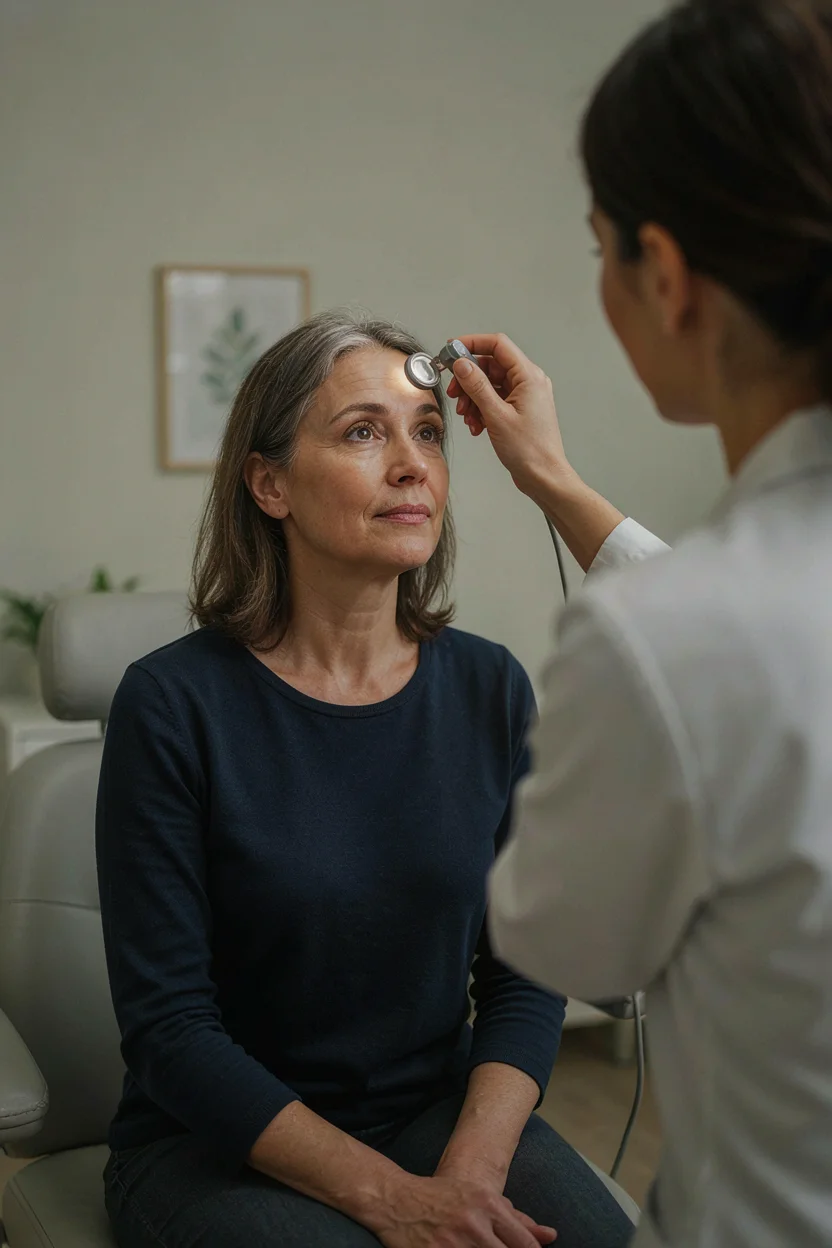
The practical threshold for seeking a professional opinion is straightforward. If you have used an anti-dandruff shampoo containing zinc pyrithione, ketoconazole, or selenium sulphide consistently for four weeks and the flaking has not substantially improved, the condition on your scalp is likely not dandruff, and continuing to treat it as such delays the management that would actually help. Four weeks of consistent use is important, because occasional use does not give the active ingredient sufficient time to reduce Malassezia populations and normalise skin turnover.
There are additional signs that point more specifically toward psoriasis and warrant a dermatologist visit regardless of how long you have been treating for dandruff.
- The flaking extends beyond the hairline onto the forehead, behind the ears, or at the nape of the neck.
- The scales are thick and silvery, sitting on raised patches with sharply defined borders that you can feel as distinct ridges.
- You have psoriasis patches on other parts of your body, such as the elbows, knees, or lower back.
- Your nails show pitting, ridging, or separation from the nail bed, which are associated with psoriasis.
- Scratching the affected area produces pinpoint bleeding beneath the scale.
- The itch is severe enough to disrupt sleep or daily concentration.
A dermatologist can distinguish between dandruff and scalp psoriasis in a matter of minutes using a dermatoscope, which reveals the scale structure, blood vessel patterns, and plaque morphology at magnification. In cases where the visual examination is not conclusive, a small skin biopsy can confirm the diagnosis definitively. The treatment paths for the two conditions diverge significantly: dandruff responds to antifungal shampoos and gentle scalp care, while scalp psoriasis typically requires topical corticosteroids, vitamin D analogues, or other targeted therapies that a dermatologist prescribes and monitors.
The cost of misidentifying the condition is not simply wasted time on the wrong shampoo. Scalp psoriasis that goes untreated can produce plaques that thicken over time, making eventual treatment more difficult and longer in duration. In some cases, the inflammation associated with psoriasis can contribute to temporary hair shedding in the affected areas, which resolves once the condition is managed but adds another layer of concern while it persists.
Frequently Asked Questions
Can I have both dandruff and scalp psoriasis at the same time?
Yes, it is possible to have both conditions present on the scalp simultaneously, and this overlap can make self-diagnosis particularly difficult. The dandruff may produce diffuse fine flaking across the crown while psoriasis plaques form at the hairline or behind the ears, and treating only one condition leaves the other unaddressed. A dermatologist can identify both if they are present and recommend a treatment plan that manages each appropriately.
Does stress make dandruff or scalp psoriasis worse?
Stress can worsen both conditions, but the mechanism differs between them. In dandruff, stress may increase sebum production through hormonal pathways, which in turn supports higher Malassezia populations on the scalp. In scalp psoriasis, stress activates the immune system’s inflammatory response more directly, triggering flare-ups that can produce new plaques or worsen existing ones. Managing stress does not replace treatment for either condition, but it can reduce the frequency and severity of flare-ups.
Is scalp psoriasis contagious?
Scalp psoriasis is not contagious and cannot be transmitted through contact, shared hair tools, or close proximity. It is an immune-mediated condition driven by genetic predisposition and environmental triggers, not by an infectious agent. Dandruff is also not contagious in the conventional sense, although the yeast species Malassezia that contributes to it is present on most people’s scalps as part of the normal skin microbiome.
Will anti-dandruff shampoo help if I have scalp psoriasis?
Anti-dandruff shampoos are formulated to reduce Malassezia populations and normalise skin cell turnover, neither of which addresses the immune-mediated mechanism driving scalp psoriasis. Some people with psoriasis report mild temporary improvement from the moisturising or keratolytic effect of certain shampoo ingredients, but the underlying plaques will persist without targeted treatment. Using anti-dandruff shampoo for four weeks without substantial improvement is itself a useful diagnostic signal that points away from dandruff.
How is scalp psoriasis treated once it is diagnosed?
Scalp psoriasis treatment typically begins with topical therapies prescribed by a dermatologist, which may include corticosteroid solutions or foams designed for scalp application, vitamin D analogues like calcipotriene, or combination products that address both inflammation and scale buildup. For more extensive or resistant cases, phototherapy or systemic medications may be considered. The treatment plan depends on the severity of the plaques, the area of scalp affected, and the individual’s broader health context, which is why professional guidance produces better outcomes than self-treatment.
Two Conditions, One Scalp
The distinction between dandruff and scalp psoriasis is one of those cases where a small amount of professional clarity saves a large amount of frustration. If your flaking has outlasted four weeks of consistent anti-dandruff treatment, the most useful next step is not a stronger product from the same aisle but a dermatologist appointment where a dermatoscope examination can settle the question in minutes. You have been looking at the same flakes for long enough; someone with the right tool can tell you what they actually are.
— Iris